
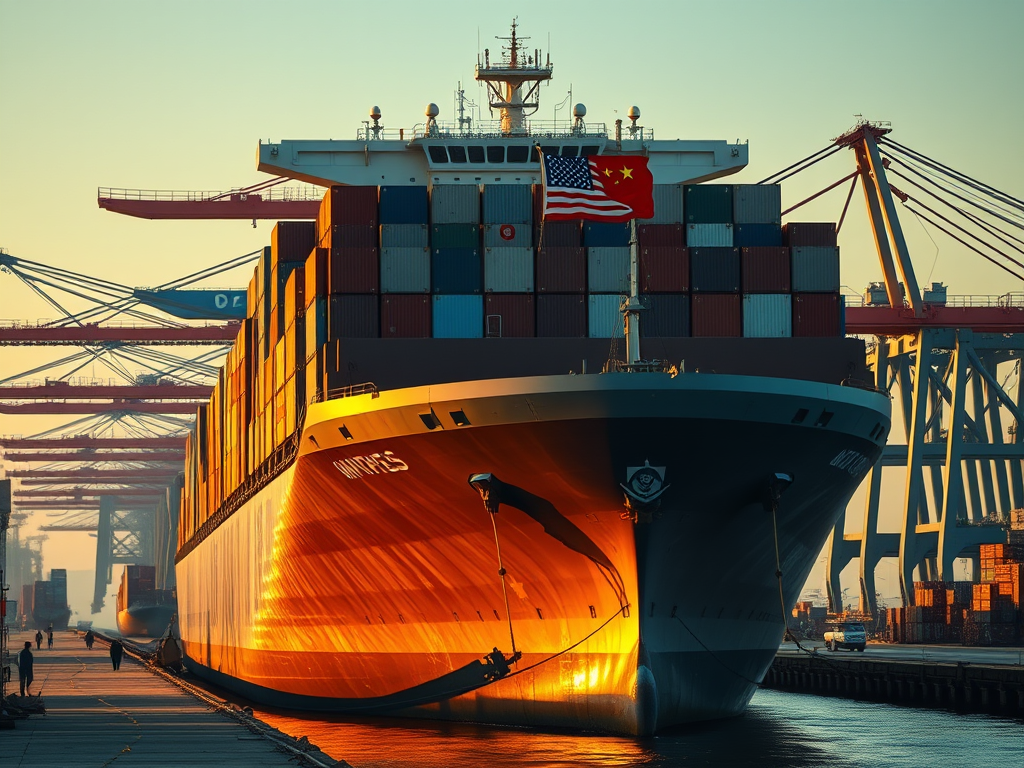
How U.S. Trade Policies Are Reshaping the Maritime Industry
By Charlie de Carbon
The maritime industry has long been shaped by the invisible forces of trade, regulation, and economic cycles. But today, a new and more disruptive force is taking the helm: geopolitics, in the form of an unprecedented trade and tariff stand off. As the United States accelerates its withdrawal from global climate commitments, it is simultaneously launching a new era of economic nationalism, one that is already sending shockwaves through global shipping.
The latest development? A proposed tiered port fee system targeting shipping companies operating fleets with Chinese built vessels. Under the new U.S. policy proposal, operators whose fleets consist of at least 50% Chinese built vessels could face a $1 million fee per U.S. port call, while those with between 25% and 50% Chinese built tonnage would be subject to a lower fee of up to $750,000 per entry. Additionally, operators with significant orders placed at Chinese shipyards may also face penalties.
This is nothing short of a maritime trade war, with the U.S. using economic pressure to reduce reliance on Chinese shipbuilding while reshaping the competitive landscape of global shipping. For fleet owners, this signals a seismic shift where a ship is built is now as financially consequential as what fuel it burns.
The New Battlefront: Shipbuilding as a National Security Issue
For decades, global fleet owners have ordered their vessels from China, South Korea, and Japan, prioritizing cost and efficiency over politics. But with this new policy, the U.S. is signaling that where your ships are built is now as important as what fuel they burn.
For global fleet owners, the financial risks of U.S. maritime protectionism are immense. Many of the world’s largest shipping operators have significant exposure to Chinese built tonnage, with up to one third of their fleets constructed in China and nearly half of their new vessel orders placed in Chinese shipyards.
Under the proposed U.S. policy, these companies could face billions in additional costs each year due to the $1 million per port call penalty. This has already triggered a wave of strategic investment pledges aimed at mitigating financial exposure, as major industry players look to align themselves with U.S. policy shifts.
This raises an urgent question for fleet owners worldwide: Are U.S. trade policies now a bigger risk factor than decarbonisation?
From Net Zero to Trade War: The New Risk Landscape for Shipowners
For years, the biggest uncertainty for fleet owners was how to comply with decarbonization regulations while remaining profitable. Now, an even greater challenge looms, how to navigate a global shipping market being fractured by economic nationalism.
This shift fundamentally changes how shipping companies must plan their fleet investments. No longer is the decision making process based purely on:
✅ What fuel should my next ship use?
✅ How do I comply with IMO and EU carbon regulations?
✅ Which efficiency technologies should I adopt?
Now, those questions must be weighed against a new set of risks:
⚠️ Will my shipyard choice expose me to financial penalties in key markets?
⚠️ Will global trade fragmentation reduce the demand for long-haul shipping?
⚠️ Will economic nationalism delay investment in alternative fuel infrastructure?
For shipowners and financiers, this is not just a regulatory shift, it’s a complete transformation of investment risk.
The Ripple Effect: A Global Reordering of Shipping and Trade
The implications of U.S. maritime protectionism will be felt far beyond its own ports. The moment the U.S. weaponised shipbuilding policy, it set in motion a chain reaction that could reshape the global maritime landscape.
• Fleet owners must rethink ship procurement strategies.
Companies will reduce their exposure to Chinese shipyards, but where will they go? South Korea? Japan? Will these shipbuilders absorb the volume?
• Other governments may follow the U.S. lead.
If Europe or the UK implements similar measures, we could see a full scale fragmentation of global trade routes based on shipyard origin.
• China will retaliate.
It is almost certain that Beijing will introduce its own penalties or trade restrictions on U.S. aligned shipping firms, further splintering global supply chains.
• Alternative fuels and net zero pathways will be disrupted.
Many of the most advanced methanol, ammonia, and LNG fueled ships are being built in China. If geopolitical tensions block these vessels from key markets, the transition to greener shipping could slow down.
Geopolitics Now Defines the Future of Shipping
For shipowners, financiers, and policymakers, decarbonization is no longer the biggest strategic uncertainty, geopolitics is.
The world of global shipping is entering an era of economic nationalism, supply chain realignment, and trade policy warfare. Whether shipowners like it or not, their fleet investment strategies will now be dictated as much by national security priorities as by market forces.
If the U.S. tariff policy on Chinese built vessels is just the beginning, then the shipping industry must prepare for a world where trade is no longer global, but fragmented by economic blocs and protectionist policies.
The seas ahead are unpredictable. But one thing is clear, the era of globalism in shipping is over and the era of economic nationalism has begun.
 Charlie de Carbon
Leave a comment